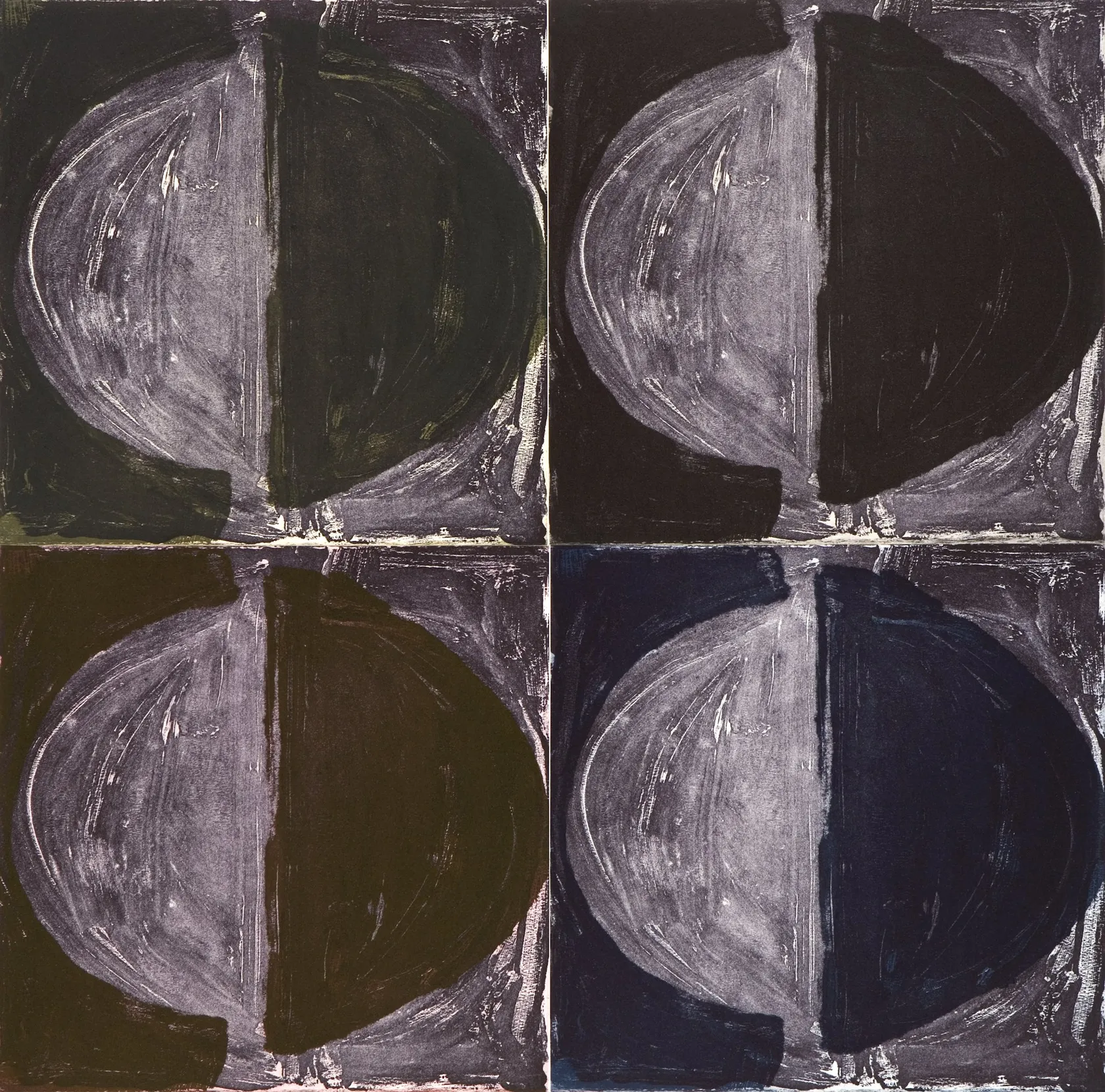
Terry Frost Black Orchard, 1997
Etching and aquatint
82 x 81 cm
32 1/4 x 32 in
32 1/4 x 32 in
Edition of 30 plus 8 artist's proofs
Black Orchard (1997) was published in a particularly productive decade for Frost’s printmaking. Orchards recur as a theme in his late prints. Frost’s abstraction is based on the formal depiction of motion and gesture, creating his own energetic emblems of crescents, spirals and semi-circles, generally hanging or balanced in the composition. His prints are not a reproduction of nature. Instead, he was interested in depicting space, light and colour, and the complex relationship between the three.
Sir Terry Frost RA (1915–2003) is one of Britain’s most significant artists, with a career spanning six decades. Born in Leamington Spa, Warwickshire, he began painting in a German prisoner-of-war camp during the Second World War, encouraged by fellow prisoner Adrian Heath. Frost credited his imprisonment with giving him a “heightened perception” of the world. Once freed, he studied at Birmingham College of Art and Camberwell School of Art in London. He was part of the pioneering generation of British abstract artists associated with St Ives, Cornwall, in the 1950s, and he is renowned for his poetic forms. His bright, exhilarating colours and shapes spark off each other like electric charges, so his work radiates energy outwards. Frost’s connection to the landscapes of Cornwall and Yorkshire and his inventive use of colour drew on the world around him. His friendship and collaboration with Flowers Gallery date back to the 1950s, and the gallery now represents the Frost Estate. His work is held in public collections including Tate, the Victoria and Albert Museum, the Metropolitan Museum of Art in New York, and the Scottish National Gallery of Modern Art in Edinburgh.
FG 03333
£2250.00
Terry Frost, Black Orchard, 1997
£ 2,250
Your shopping bag
This purchase may be subject to local rates of import, sales and use taxes for which the purchaser is 100% liable.
No items found
Close
Your saved list
Create a list of works then send us an enquiry.
No items found